
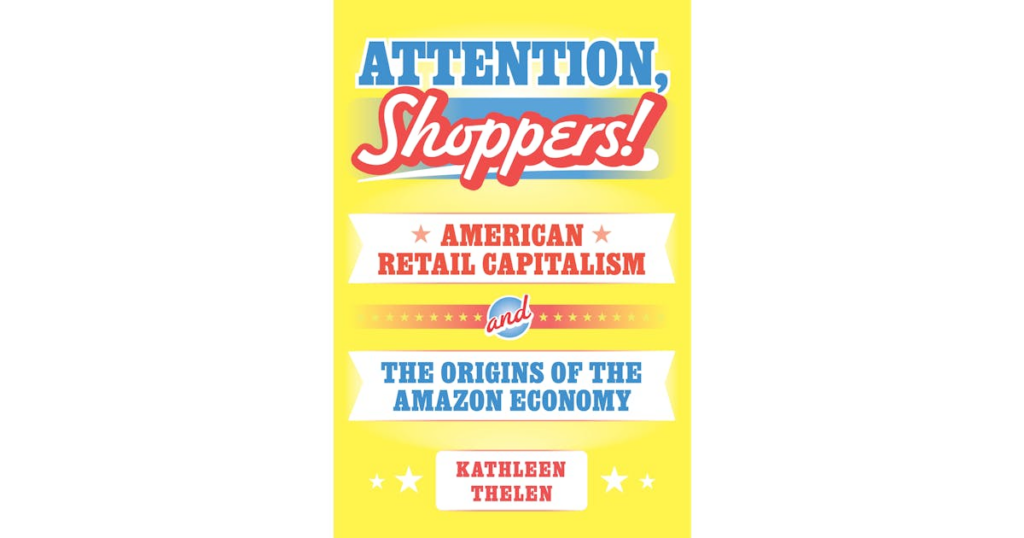
The burgeoning literature on the platform economy has shown us a great deal about how digital technologies have reshaped the distribution of power within contemporary capitalist societies. But this literature has exhibited two notable weaknesses: the rarity of historical approaches (especially notable in the literature on gig work, which has heavily relied on interview and ethnographic methods) and the tendency to neglect political influences, (which have often hastened the growth of high tech firms in myriad ways). Both of these limitations are addressed in Kathleen Thelen’s new book, Attention Shoppers! American Retail Capitalism and the Origins of the Amazon Economy. Though it does not deal with platform capitalism as its central focus, the book provides a rich comparative-historical analysis of the political structures that have led to the dominance of retail giants like Walmart and Amazon. The result is a model of skillfully executed scholarship that holds important lessons for scholars and activists concerned with the ascent of the digital behemoths that have come to dominate so many facets of our everyday lives.
Thelen’s argument rests on four interrelated themes. One is that the evolution of the retail sector has been far more influential than comparative political economists (and others) have allowed. Breaking with the usual emphasis on the production side of the political-economic equation, Thelen argues that the retail sector has come to enjoy a degree of power and centrality that political economists can no longer ignore. This is particularly true of the United States, where retailers have come to dominate not only the sale of consumer goods but also the internal operations that their suppliers maintain throughout their supply chains, not only within the US but across wide swaths of the globe.
A second and related point is that the power that national retail giants have come to enjoy is not a recent development; rather, the political economy of the United States has long empowered large retail firms with national clout, reaching back to the days of Montgomery Ward and Sears and Robuck, Amazon’s predecessors, which enjoyed a far more favorable environment than did their counterparts in Western Europe. The reason for this difference, Thelen contends, can be traced to the specifically political traditions that have existed in the American context –especially, the country’s anti-trust policies (which have blocked any role for producer and consumer cooperatives of the sort that European societies have allowed) and its fragmented political landscape (which has enabled national retailers to pit state regulators against one another). One of the strengths of Attention Shoppers! lies in its ability to unpack the coalitional dynamics that have developed over time, with national retail chains have engaged in legislative, judicial, and ideological battles with local retailers, manufacturers, and one another in their efforts to gain control over the domestic market.
A third and perhaps most provocative feature of Thelen’s book is its suggestion that the power that retail capitalism has come to wield in the United States has had far reaching effects on American culture, encouraging Americans to equate citizenship with the trappings of consumption and to define progress in terms of prosperity –cultural traits that have discouraged identities rooted more firmly in the sphere of production and thus limiting the development of class consciousness on American shores. Thelen approvingly quotes cultural and economic historians like Charles McGovern, Lawrence Glickman, and Lizabeth Cohen, who speak of the distinctly American tendency to view “spending as a form of citizenship” (Thelen, p. 73) and of an historical shift, evident in early 20th century America, that moved working class consciousness “from the shop floor to the store front” (74).
A fourth and perhaps most fundamental facet of Thelen’s argument is that many of the novel practices that Walmart and Amazon have introduced (especially those involving data collection, logistics technologies, and predatory pricing strategies) are in fact longstanding features of American retailing. Efforts to dominate national consumer markets, to collect detailed information about customer behavior, or to use market power to undercut the position of nationally recognized brands have long histories in the retail sector, and were key to the ascent of firms like Montgomery Ward, Sears and Robuck and the A & P, the Amazons of their day. What is remarkable is how much popular support such firms were able to garner at earlier moments in American economic history, often deploying a rhetoric centered on pricing strategies that claimed to empower their customers, who gained a newfound freedom from their dependence on local retailers alone.
Much of Thelen’s book is devoted to detailed analysis of shifting legislative, regulatory and judicial landscape that emerged at both the national and state levels, as various constituencies sought to mobilize these bodies on their own behalf. At various moments, established retailers, discount upstarts, manufacturers, and consumer groups all engaged in struggles to define the rules of the retail game. At stake were the contours of anti-trust policy, as expressed in a number of key issues, such as the right of manufacturers, retailers and state legislatures to control the pricing strategies that would prevail across the industry (which were vital to the profits of the contending firms). Thelen acknowledges that the rise of neoliberal thinking in the 1970s greatly benefited the retail giants, since it redefined market power as beneficial to consumers. But by that time, she alleges, the retail giants had already amassed sufficient power as to defeat virtually any and all efforts to tame their predatory powers. Though there was a virulent populist movement that challenged the retail chains in the 1920s and 1930s (as evident in the Robinson-Patman Act of 1936, the Miller-Tydings Act of 1937, and a spate of state level efforts to inflict pain on the “chain store menace”), “it was all too little and too late, chains had grown to massive scale and assembled a broad and diverse coalition of support” (165) –a coalition that very much included consumers themselves.
Perhaps the most important point that emerges from Thelen’s analysis concerns the ironic paradox in which many American workers are trapped: Given the decimation of trade unions, the wage stagnation that workers confront leaves them ever more dependent on the very cost-cutting retailers that have spread the low wage employment model across so much of the American economy. As she notes (p. 284), “American consumers are often drawn into an alliance with low-cost retailers and therefore into complicity in the strategies they deploy.” The way out of this trap, Thelen concludes, is not likely to emerge via consumer-based movements alone, since the problem is rooted in structural features of the US political economy that must themselves be addressed: anti-trust policies that incentivize the reduction of labor costs, a fragmented political landscape that invites regulatory arbitrage, and courts that have consistently empowered large corporations over workers, their organizations, and the communities in which they live.
Attention Shoppers! is certainly vulnerable to critique on several fronts. First, the book’s emphasis on the theme of continuity rather than change weakens its ability to provide a clear periodization of the changes through which the retail field has evolved. The book provides a compelling analysis of the legislative battles shaping retail capitalism at the federal and state levels, it only occasionally steps back to conceptualize these macro-historical shifts. Is retail capitalism a distinct stage in the development of contemporary capitalism or instead a field within the US political economy? How does the advent of retail capitalism bear upon earlier shifts, e.g., those which birthed the shareholder conception of the firm? Sadly, Thelen neglects theoretical or conceptual issues such as these (see, however, the suggestive analysis of 21st Century capitalism that can be found in Rahman and Thelen, 2019).
A second, related limitation in Attention Shoppers! is the book’s relative neglect of the digital technologies that Walmart, Amazon, and other firms have used in their effort to institutionalize the on-demand economy. It seems fair to suggest that digital platforms, cloud computing, personalized advertising, and now artificial intelligence have all empowered firms to an extent which their predecessors could never have imagined. (Put differently, Thelen uses the term “Amazon economy” in so narrow a way as to hive it off from the larger algorithmic ecosystem to which it belongs.) The cost of this limitation is that important events on the retail horizon, such as the rise of live-streaming commerce, cannot be glimpsed. Yet more and more of our shopping behavior (and our dollars) are being sucked into influencer-driven sites on platforms like Instagram, YouTube, Twitch and TikTok, whose attractive powers rival the gravitational pull of black holes. Indeed, revenues in this digitally governed domain have risen from $22 billion in 2020 to $104 billion in 2025, and are predicted to rise by another 50% by the end of the decade (Statista 2026). It seems difficult to reconcile these developments, which represent a novel confluence or fusion of social media, advertising, entertainment and retail firms, with the emphasis on continuity that Thelen’s book has stressed.
These objections notwithstanding, Attention Shoppers! contains an important and provocative corrective to the production-centered assumptions that so many of us labor scholars have adopted –assumptions that have too often reduced the sphere of consumption to a mere afterthought. Moreover, the book arrives at a propitious time, when the issue of affordability has gained so much purchase over the American electorate. Indeed, Thelen’s book helps explain why the affordability debate has remained so narrowly focused on consumer prices, with virtually no attention to the stagnation that has engulfed wages and the consistent upward drift of corporate profits. We are so thoroughly trained to focus on the prices we must pay as buyers of commodities that we seldom stop to consider our role as sellers of our most important commodity –our own labor time.
Thelen concludes her book with a clear and difficult challenge to us all. Escaping the trap of retail capitalism will be impossible unless we can address its structural roots, which lie in a political system that permits regulatory arbitrage and in an anti-trust policy that incentivizes low wage employment. This challenge is made all the more difficult in that the solution presupposes the very producer-based outlook that consumerism has blocked. Ultimately, our prospects hinge on whether political and economic elites can manage the affordability debate, or whether the stresses and contradictions of retail capitalism will evolve beyond their control. Perhaps they already have.

 The current trend for fashionable post- and anti-work thinking has been given a boost by David Graeber’s book