
.jpg)
We are living in a new Gilded Age. A tiny sliver of the population gets richer and more powerful every day. Most of these billionaires and politicians want what elites have always wanted: to ensure their kids inherit their elite status.
Some will successfully entrench their families in the upper class, and some won’t. In a new study, I ask how some elite families successfully entrench themselves in the upper class while others don’t. I argue that individual control over vast fortunes does not in and of itself guarantee elite heirs. Upper-class entrenchment is a collaborative family project that cannot be reduced to wealth alone.
More specifically, I argue that families that closely combine great wealth, status, and power – what I call “kinship interlocks” – are especially able to entrench themselves in the upper class, because they exchange resources among themselves in ways that both protect them from risk and propel them into more resources. In other words, cementing a dynasty long-term is not a matter of wealth, power, or status alone; it’s all three.
From dynasties to webs
This family-based perspective is important because social scientists and laypeople alike tend to imagine elites mostly as individuals – billionaires, CEOs, and presidents – and sometimes as distinct dynasties defined by individual “founders.” But individual tycoons and tyrants are typically enmeshed in densely tangled webs of elite kin. That’s because elites everywhere tend to marry each other, and more often than anyone else, they tend to produce elite kids. My research has shown that these basic patterns can connect individually rich and powerful people in massive, continuous elite family networks in a matter of decades.
My argument is based on many years assembling a huge quantity of archival data. I hand-constructed a relational database consisting of all economic, political, and social elites and the full upper class for Dallas, TX in its first century and a quarter (1841-1963; >20k people) and all their mutual family ties. The dataset is essentially a much larger-scale, more structured version of family genealogical research.
The defining feature of the dataset is family entanglement: most (at least 78%) elites were closely related in a massive hairball of family, depicted below.
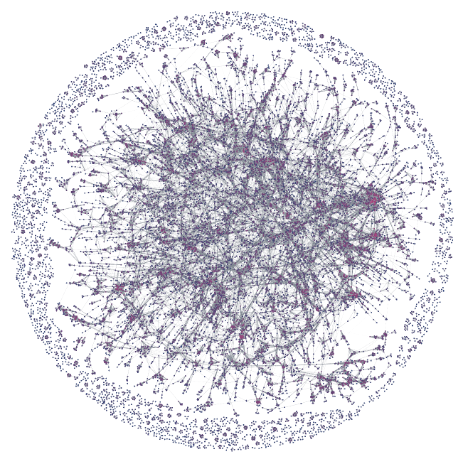
It’s important to understand that this level of elite family entanglement is not unique to Dallas from 1841-1963. Scholars have uncovered elite family hairballs in many other settings around the world and across history. If anything, elite populations are likely much more entangled in other cases, because this covers the start of colonial settlement in Dallas, meaning the network formed in a matter of decades entirely from scratch.
How kinship interlocks generate upper-class persistence
Using these data, I first show quantitatively that kinship interlocks produced upper class descendants at remarkably high rates. And the closer families were to kinship interlocks, the more often they persisted. This is exactly what we would expect if kinship interlocks did generate upper-class persistence.
But that quantitative analysis can’t explain how elites did or did not persist. So I randomly sampled families at each possible combination of elite kin ties and persistence: people who fit the pattern of kinship interlocks being more durable, people who defied the pattern, and everything in between. For each of these 106 case studies, I pulled together all the information I had from archival records to tell the story of their family’s (non-)persistence. Replication data are available here and summaries of all case studies are available in an appendix to the article.
Through the case studies, I found that the intimate exchange of resources in kinship interlocks cemented families in the upper class through two mechanisms: it protected kin from economic, social, and legal risk, and it propelled them into more resources. You can think of this “protect” mechanism as the formation of a multidimensional, multi-person safety net, and the “propel” mechanism as a multidimensional, multi-person process of cumulative advantage, or “the rich get richer.”
Along the way, I found that the concentration of wealth, status, and power in families continually creates collections of people who are practically immune to all kinds of risks: not only to downward mobility, but also to any kind of legal or social accountability for their nefarious deeds. People in kinship interlocks had remarkable freedom to lie, steal, cheat, exploit, assault, and murder with impunity. Of course, we see this kind of thing in the news every day.
In the paper, I highlight a case of a diamond thief, John T. Higginbotham Jr., who got away with stealing millions of dollars of jewels from some of the richest women in the city. Not only was John born to a Dallas kinship interlock; his first cousin married the debutante granddaughter of President Franklin D. and Eleanor Roosevelt. As the journalist Rena Pederson observed, “the Higginbothams didn’t just know ‘the right people,’ they were the right people.”
On the other hand, I found that people in kinship interlocks are also highly constrained by norms of family-making, gendered labor, and property. To fully benefit from a kinship interlock, they have to follow the “rules of the game” for making family and sharing resources, and those rules are co-constitutive with local systems of race, gender, and sexuality. People who break the rules get nudged or flung out of the protection and propulsion of a kinship interlock.
The Dallas diamond thief, for example, may have gotten away with extravagantly breaking the law, but he was also secretly gay, and when he began inching away from public heteronormativity, he began to face some material consequences.
Altogether, we can think of upper-class persistence as a continual choreography of conformity and exclusion. Some potential heirs may fail or rebel, but the upper class lives on. These processes can help explain why upper classes are typically racially dominant and heteronormative – why, even in the contemporary U.S., rich and powerful families are so much whiter and straighter than the rest of us. It also means we can’t understand our new Gilded Age through presidents and billionaires in isolation. When it comes to the long-term dynamics of economic, social, and political domination, family is still where the action is.
Shay O’Brien. “Kinship Interlocks: How the Intimate Exchange of Wealth, Status, and Power Generates Upper-Class Persistence” in American Sociological Review 2026.
About the Author
Shay O’Brien is currently the James M. and Cathleen D. Stone Center Postdoctoral Associate at MIT, and will join the UC Berkeley Sociology Department as an Assistant Professor in January 2027. She studies the kinship networks that weave elites together.
Further Reading
Shay O’Brien. “The Family Web: Multigenerational Class Persistence in Elite Populations” in Socio-Economic Review 2024.
Shay O’Brien. “Unnatural Wills: Inheritance Disputes and Inequality” in British Journal of Sociology 2025.
Shay O’Brien. “The Gender of Inheritance in an Upper-Class Family Network: Dallas, 1895-1945” in Socio-Economic Review 2025.