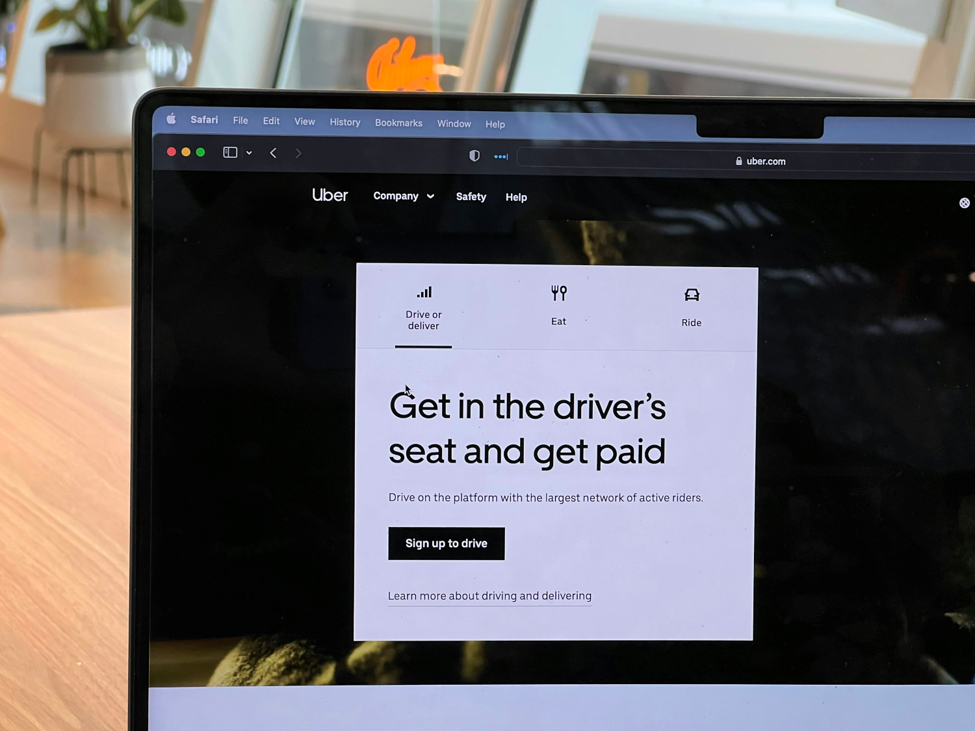
Uber likes to market itself as the future of work.
In a recent article, we argue that it also belongs to a much older American story: a line that runs from multi-level marketing organizations like Amway, through franchises like McDonald’s, to today’s platforms.
We call that longer history sponsored entrepreneurship. These are business models that invite people to act like independent entrepreneurs while supplying the brand, product, infrastructure, or operating system from above.
Image: Amber-1 livestreaming for a top skincare brand. Screenshot by the author.
Just after midnight in a Hangzhou, China livestreaming studio, a woman sells skincare to an audience of strangers. Her name is Amber-1. She blinks, tilts her head, and holds eye contact a beat too long as she works through her pitch in polished, tireless Mandarin: “This cream is what every girl dreams of. This is our star product. Its ingredients are…” She will keep going until sunrise, because Amber-1 is an AI avatar, and she never needs to sleep.
Viewers notice. “Robotic,” one writes. “Fake,” “AI,” others chime in. They are right, and in this studio it does not matter. By morning, Amber-1 will have sold roughly 60 percent of what her human predecessor sold in the same overnight slot, at a fraction of the cost. Within months, the agency that runs this channel will cut its roster of human streamers from six to two.
In 2025, officials in the Trump administration proposed overhauling the U.S. refugee system to favor White applicants. Their rationale cited a familiar academic claim: that ethnic diversity weakens social trust and community bonds.
Mario and Emma, two young college graduates in Spain and the U.S., were both unemployed, having trouble making ends meet, and dependent on financial support from their families. They shared similar experiences with “socioeconomic insecurity” (defined as employment precarity and economic instability). But, as they talked to me about their experiences and plans, they revealed very different perceptions of how insecurity textured their lives. For instance, Mario described a sense of being stalled waiting for better conditions: “There’s a lot of plans we can’t make now, and we have to hang on with what we have.” Emma, in contrast, described a sense of being in constant movement, trying to figure out a way forward: “You go with the flow and you make it work no matter what.”
In my recent article, published in Work and Occupations, I sought to understand these cross-national differences. I asked: How do people perceive socioeconomic insecurity? Where do their perceptions come from, and what are the consequences?
Image: Kennedy family portrait, July 1938. Dorothy Wilding via Wikimedia Commons (in the public domain).
We are living in a new Gilded Age. A tiny sliver of the population gets richer and more powerful every day. Most of these billionaires and politicians want what elites have always wanted: to ensure their kids inherit their elite status.
Some will successfully entrench their families in the upper class, and some won’t. In a new study, I ask how some elite families successfully entrench themselves in the upper class while others don’t. I argue that individual control over vast fortunes does not in and of itself guarantee elite heirs. Upper-class entrenchment is a collaborative family project that cannot be reduced to wealth alone.
In 2020, more than two million platform jobs were added to the U.S. economy. Workers are drawn by the prospect of flexibility in a job without fixed schedule and the potential to earn money on-demand. Yet the same apps that promise independence often leave workers dealing with low pay, uncertainty, and long hours.
In a recent article, we argue that this tension, between rhetoric and reality, it is central to how platform work operates.
We call this tension the platform paradox: platforms invite workers to see themselves as independent entrepreneurs while quietly tightening control over how they work, present themselves, and spend their time.
Organizations invest heavily in systems meant to ensure fairness—competency models, structured interviews, standardized performance reviews, and carefully crafted criteria for promotion.
Yet anyone who has spent time inside a workplace knows that decisions rarely follow the prescribed rules. A candidate isn’t quite the “right fit.” An employee “lacks presence.” A manager can’t quite “see” someone in a leadership role. These intuitive, seemingly harmless phrases reveal something deeper about how advantage is sustained.
Gender discrimination at work is illegal in the United States–but occupational gender segregation persists nonetheless. Though social arrangements of gender have changed significantly over the years and are in persistent flux, gender norms remain pervasive in many aspects of modern society. But in a country that has outlawed outright discrimination in hiring, how do job recruitment advertisements perpetuate gendered segregation?
In a recent paper published in Social Problems, I explore how online job platforms geared towards Chinese immigrants enforce occupational segregation for the restaurant and nail salon industries. Through a qualitative analysis of the 168worker platform, I find that employers maintain gender homogeneity in male-dominated restaurant kitchens and female-dominated nail salons through explicit discrimination, while also broadcasting gender norms that reproduce traditional enactments of masculinity and femininity on the job.
Back in the 1990s, my paternal grandparents lived in a condominium in a middle-class neighborhood in Mexico City. To get to them, you had to pass through Fortino, the portero—the building’s doorman. I remember him in the marbled lobby or just outside the entrance, always impeccably dressed, fiddling with a toothpick, and a rattling keychain. He greeted us warmly, remembering all our names, even in a building with over fifty apartments and hundreds of visitors. Fortino was more than a gatekeeper. He lived in a small service apartment and handled everything from parking cars and small repairs to carrying suitcases and passing along messages, long before cell phones were common. A legacy of the colonial estates, porteros like Fortino had no formal training, yet controlled access and maintained security through familiarity and trust. Across twentieth-century Latin America, porteros were a familiar figure in every major city, forming the backbone of a private security system based on patronage relations and even becoming cultural icons, immortalized by comedians like Cantinflas.
But over the past thirty years, porteros have been gradually replaced by private security firms, uniformed guards, and strict security protocols. Global security firms like Securitas and Allied Universal and domestic providers have created an entrepreneurial model of private security, combining risk assessment, protocols, and surveillance technologies with aesthetic standards that link authority to client prestige. Unlike the more lenient expectations of porteros, disciplined posture, polished uniforms, and performative attentiveness are now central to how security is produced, reassuring clients while deterring potential assailants.
A 2024 Saturday Night Live sketch takes viewers to an airplane cabin where a pregnant passenger in labor seeks a doctor, but no one on board is qualified. So, one passenger—a lawyer—volunteers to help on the basis that he has the “second best job” after doctor. Other passengers then jump in with their own claims about engineers, teachers, and mothers being the rightful number two. Debate ensues, leaving both the pregnant woman and the occupational hierarchy in limbo.
Yet previous sociological work on occupational prestige suggests there is one true ladder and ‘everyone’ knows it. If that’s the case, then why does the SNL sketch resonate?
In our recent research, and in previous work, we reconsider how Americans perceive the occupational hierarchy, a concept at the heart of stratification research. We find that the apparent consensus around occupational prestige primarily reflects the views of a small group of highly educated Americans. People outside this group deviate from this consensus, but not in systematic ways, leaving the elites’ consensus to dominate. In the end, there’s much less agreement about the status of occupations than estimates have suggested.










.jpg)