
In 2025, officials in the Trump administration proposed overhauling the U.S. refugee system to favor White applicants. Their rationale cited a familiar academic claim: that ethnic diversity weakens social trust and community bonds.
But what if that research got the story wrong?
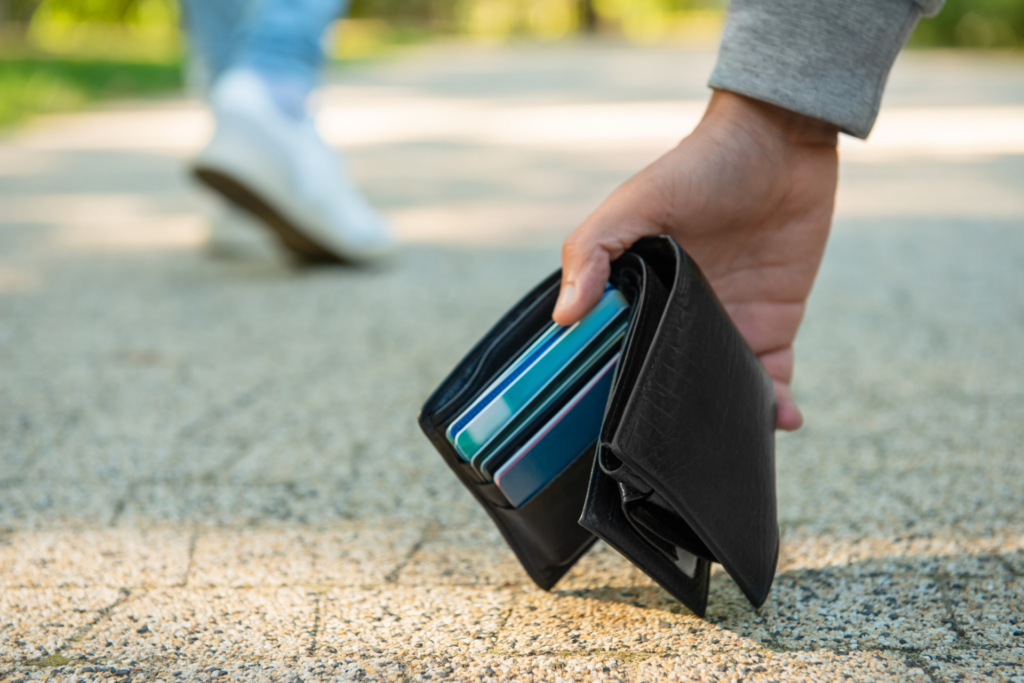
We “lost” nearly 1,800 wallets across 60 New York City neighborhoods to find out. We scattered the wallets across neighborhoods ranging from diverse to single-race, and rich to poor, then waited to see how often they came back and whether return rates varied with the characteristics of the neighborhood, the wallet owner, or both.
As we report in our recent paper, we found that ethnic diversity had nothing to do with wallet returns. What mattered was poverty.
The experiment
We used clear card holders for wallets, so anyone walking by could see the contents without picking them up. Each wallet held business cards with the owner’s face, name, and occupation, to signal race and socioeconomic background; a house key (valuable to the owner but useless to a finder); and a grocery store receipt. Some also contained a bone marrow donor card, signaling the owner as someone who helps strangers. Others instead included a liquor store receipt, a mild signal of vice.
We varied the wallet owners’ apparent race––White, Black, Latino, or Asian––using names and photos systematically validated in prior research. Job titles, again systematically validated, signaled socioeconomic status: software engineer or accountant for high status, painting contractor or flooring installer for low. Both race and socioeconomic status were randomly assigned.
We chose New York City deliberately. Unlike most of the United States., NYC has non-White neighborhoods that aren’t poor, as well as diverse neighborhoods across the income spectrum. This let us pull apart the effects of diversity from the effects of poverty, which most prior studies simply couldn’t do.
What we found
Forty percent of wallets were returned across New York City overall. But at the neighborhood level, patterns diverged.
The most affluent neighborhoods in our sample, where median household income was ~$177,000, returned wallets at roughly twice the rate of the poorest ones, where median income was ~$25,000: 63 percent versus 30 percent. Neighborhood income was the strongest, most consistent predictor of whether a wallet came back.
And diversity? Once we accounted for income and other neighborhood characteristics, it had no relationship to return rates. In some models, more diverse neighborhoods actually showed higher return rates, though not consistently enough for us to draw firm conclusions. The popular claim that diversity erodes cooperation found no support.
The reason earlier studies reached a different conclusion comes down to sampling. In most of the United States and Western Europe, diverse neighborhoods tend to also be poorer and have larger ethnoracial minority populations. Past research has rarely been fielded in study sites that included enough affluent diverse communities, or enough non-White homogeneous ones, to tell apart diversity from poverty and minority share. When you can’t separate diversity from disadvantage, it’s easy to mistake diversity for what is actually a product of poverty.
Who receives help?
The most striking finding may be what didn’t matter: the race and class of the person who lost the wallet.
Return rates were statistically indistinguishable across high- and low-socioeconomic-status wallet owners, as well as across owners from different racial groups. This held even in racially homogeneous neighborhoods, where you might expect residents to favor people who look like them. Instead, a Black man’s wallet was just as likely to be returned in a predominantly White neighborhood as a White man’s wallet was, and vice versa.
Yet, New Yorkers did respond to one thing: whether the wallet owner seemed like a good person. Wallets with bone marrow donor cards were returned at significantly higher rates than those with grocery or liquor store receipts. What mattered was evidence of individual prosocial behavior, not what racial or socio-economic group the owner belonged to.
Sociologists distinguish between “parochial” prosociality, where people help their own, and “generalized” prosociality, as when helpfulness extends to strangers regardless of background. Our results point toward the latter, consistent with what classical sociological theorists predicted would happen in large, diverse cities.
Why it matters
If diversity itself weakens community bonds, then the logical policy response is to limit mixing: restrict immigration, resist integration. That argument has been made explicitly. Robert Putnam’s influential claim that diversity causes people to “hunker down” has been invoked against immigration and affirmative action.
Our findings tell a different story. Diverse neighborhoods are not less cooperative; poor neighborhoods are. The problem is concentrated economic deprivation, not ethnic composition. That calls for investment in struggling communities, not restrictions on who can live where.
A resilient city of strangers
There’s something to the image of a New Yorker finding a stranger’s wallet on the sidewalk. They see a face, a name, a job title. They know nothing else about this person. And four times out of ten, they pick up the phone or send an email or text to get it back to the owner, regardless of whether that person is White or Black, rich or poor.
We don’t want to overstate the case. Returning a wallet is a low-stakes act. In higher-stakes domains like hiring and housing, research shows that race discrimination persists. Additionally, New York City is unusually large and dense, at least among cities in the United States, which may limit the reach of these findings.
Yet, the arc of human history has bent toward urbanization and differentiation. When it comes to social organization, a dense, diverse city like New York is likely less an outlier than a preview. Our findings undercut a generation of pessimism about this trajectory. The fabric of diverse societies may be more resilient than the research used to dismantle them has claimed. Modern societies are held together not by the tight bonds of sameness, but by something looser, broader, more impersonal, yet perhaps also more durable.
Read more
Rieger, Shannon, Delia Baldassarri, and Maria Abascal. “Diversity and Prosociality in NYC Neighborhoods: Evidence from a Lost Wallet Experiment” in American Journal of Sociology, 2026.
Authors
Shannon Rieger is currently a user experience researcher at Meta. She conducted the experiment and co-authored the article discussed in this blog as a sociology PhD candidate at NYU.
Maria Abascal is an Associate Professor of Sociology at NYU. Her research deals with racial/ethnic diversity, and the project described in this post was funded by her NSF CAREER Award.
Delia Baldassarri is Silver Professor at NYU. The field-experimental research presented in this article is part of her line of work on solidarity and cooperation in complex, modern societies.