
Social scientists are raising alarm about the “end of work” and the “post-work society.” Whether caused by AI, financialization, gigification, or something else, the future of work is uncertain. What happens to gender inequality when jobs disappear? In this post, I imagine four scenarios about men’s and women’s future labor force participation and their implications for feminism and feminist sociology today.
Of course, not everyone believes that massive job loss is in our future. Some social scientists believe that AI and automation will increase the number of jobs. Maybe new jobs will replace those that will be eliminated. But in this post, I want to take seriously the possibility of massive job loss, asking what it could mean for the future of gender inequality.
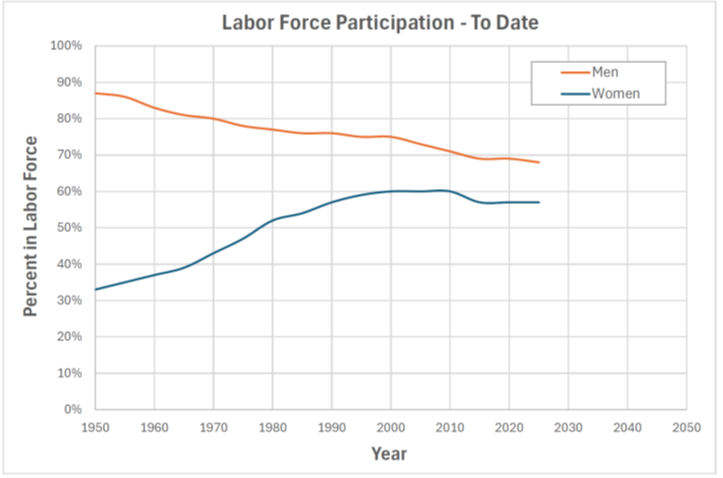
I begin with a chart showing what men’s and women’s labor force participation (LFP) looks like over time. These data are from the Bureau of Labor Statistics. For my purposes, I smoothed out the lines. What we see over time (beginning in 1950) is a steady decline in men’s LFP matched with a rapid increase in women’s LFP—until 15 years ago or so, when the trend lines started to flatten out.
What might a future 15-20 percent decline in jobs look like? I will present four different scenarios and discuss the social conditions that might lead to that outcome.
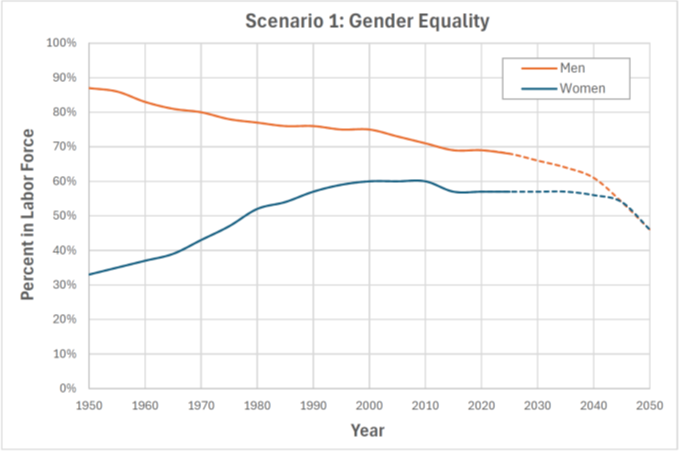
The first scenario I call the “Gender Equality” perspective. The idea is that the rates of men’s and women’s LFP will eventually converge and then decline together. This model assumes that job loss will impact all occupations similarly, or that occupational segregation will diminish. Moreover, for men and women to contribute equally to the workforce would require shared responsibility for domestic work. Gender equality would also require the equal distribution of jobless benefits.
None of these assumptions are supported by sociological research. Occupational segregation is not diminishing; women continue to perform most of the housework and childcare, and the US system of unemployment insurance primarily benefits elite white men. For this future to unfold, feminists must continue to work toward gender equality at work and at home, and fight for gender equality in jobless benefits.
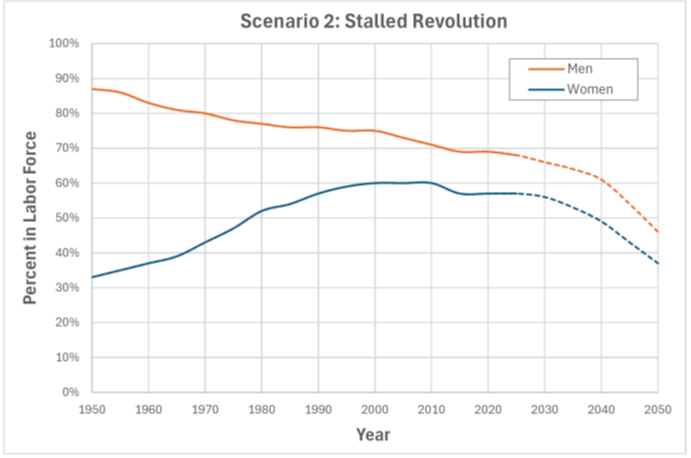
The second scenario I call the “Stalled Revolution” model. Paula England uses this term to emphasize that progress toward gender equality has slowed in recent decades, and on some measures—such as labor force participation—even stalled. This second scenario reflects this perspective. It conceptualizes a decline in both men’s and women’s jobs, with the steady gap remaining through the period of job loss.
England attributes the stalled revolution to women’s ongoing and unequal domestic responsibilities; the persistence of occupational segregation; the devaluation of activities and jobs traditionally done by women; and strong beliefs in gender essentialism
Thus scenario #2 seems likely to unfold barring any changes to our current gender arrangements. This is not a feminist future unless a massive support system for unemployed men and especially women, were implemented.
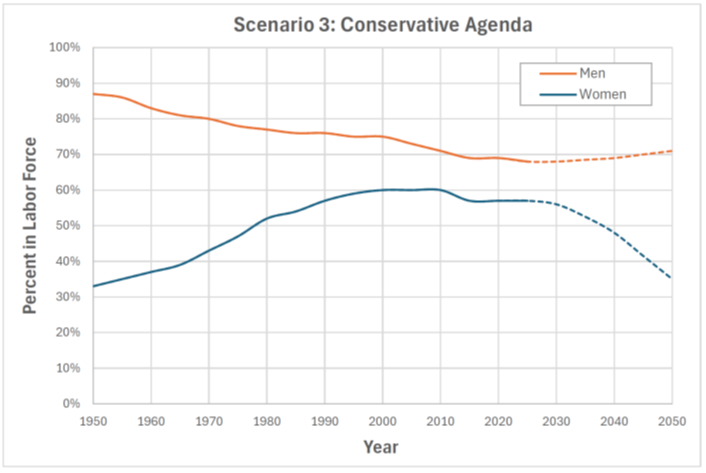
The third model I am calling the “Conservative Agenda”. This imagines a nostalgic return to the past, with men as breadwinners and women as homemakers dependent on men’s incomes. This assumes an increase in men’s LFP and a decrease in women’s LFP.
This scenario seems unlikely today. In the past, the male breadwinner/female homemaker model was upheld by a manufacturing economy dependent upon women’s domestic labor. Over time, this arrangement unraveled due to globalization (movement of manufacturing jobs out of the country); the rise of the service economy that commodified women’s previously unpaid domestic labor; and the feminist movement, in particular, women’s access to higher education and reproductive rights.
However, forces are at work in the U.S. to make this imagined future a reality. Our current Presidential Administration supports bringing back manufacturing jobs (shutting down borders and imposing tariffs on trade); decommodifying women’s work (by glorifying the “trad wife” and encouraging high fertility); and rolling back feminist gains by reinforcing the gender binary (anti-LGBT policy); weakening anti-discrimination laws (eliminating Affirmative Action and DEI); and banning abortion and contraception (Dobbs decision ending Roe v. Wade; Comstock Act to prohibit mailing contraceptives). The goal of these policies is to reinforce patriarchy. Obviously, most feminists oppose this agenda.
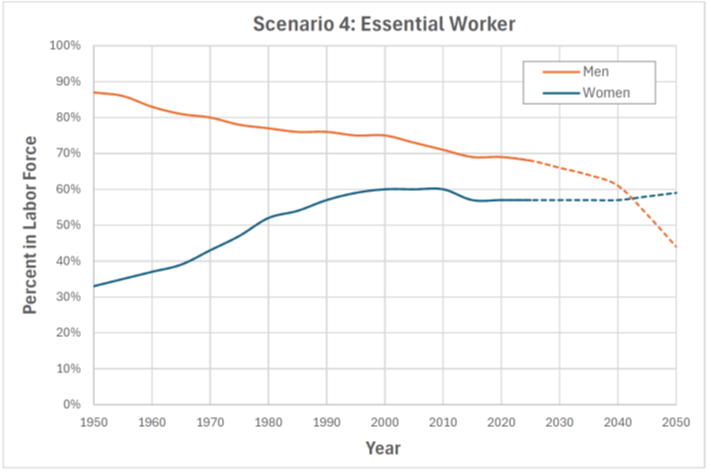
In the fourth scenario, which I call the “Essential Worker” model, I imagine that women increase their LFP rate while men’s LFP continues to decline. This assumes continued occupational segregation, with job loss concentrated in men’s jobs and continued if not increased demand for women’s jobs.
I call this the “essential worker” model because this was the label given to workers who were required to show up in person to do their work during the pandemic. It quickly became apparent that the category of “essential worker” was gendered. Women and especially women of color were overrepresented among the “essential workers” because of the jobs where they were located. There may be lessons here for what a jobless future will look like. It is possible that jobs that are today female dominated will be the last human jobs.
This is a hypothesis suggested by Allison Pugh in The Last Human Job. Pugh identifies the kind of work that computers and AI are (so far) not able to do. She argues that these jobs all require in person, human connection. She develops the concept of “connective labor” to describe the skills involved in doing this work.
Connective labor is defined as a form of carework that requires mutual recognition. To perform this work successfully, the worker must understand and often intuit the needs of another person; while for their part, the recipient of connective labor must trust the worker to have their best interests at heart—thus the mutuality involved. This mutual recognition can only be achieved through interpersonal interaction. It develops in the moment—it cannot be predicted in advance—as it requires a nuanced back-and-forth between the worker and the client or recipient of care.
These connective labor skills are often found in the health care and education sectors—female-dominated jobs that grew during the pandemic—and maybe will continue to grow. Pugh also includes therapists and sex workers in this category of those who perform connective labor—these are also female dominated jobs. Computers cannot yet replace humans who do this work.
In contrast, jobs that involve logical precision, data analysis, and mathematical reasoning are more easily replaced by AI. Interestingly, these are qualities often associated with hegemonic masculinity and male-dominated professions. Thus, Pugh is suggesting the possibility that the future of work may be female. The qualities currently associated with women and femininity—subjectivity, empathy, caring—are precisely those that AI cannot (yet) replace. The last human workers may be women!
Is this a feminist future worth fighting for? If the future labor force is female, this might result in women’s empowerment vis a vis men. As Friedrich Engels argued over a century ago, access to wage labor has long been the basis of male domination. If women come to monopolize paid work, this could mean a return to a matriarchal society.
The opposite could also happen: Paid work becomes something that women are forced to do, while elite men enjoy increasing leisure and receive income from something other than a job. The image is less Friedrich Engels and more Margaret Atwood.
In other words, scenario #4 may not be a rosy future for women. Gender inequality and hegemonic masculinity have a nasty habit of morphing to accommodate changes in the economy. This may not be a future worth fighting for.
Conclusion
Many people today are predicting the end of work. The impact on gender inequality is uncertain, but it could be catastrophic. Feminists have long tied women’s liberation to their labor force participation. Granted the possibility of the end of paid work, it might be better to spend less attention on equal employment opportunities and more effort designing alternative distribution systems for a future without work.
For additional reading
Attwood, Margaret. 1998. The Handmaid’s Tale. Anchor books.
Center for Economic and Policy Research. 2020. https://cepr.net/publications/a-basic-demographic-profile-of-workers-in-frontline-industries/
Damaske, Sarah. 2021. Tolls of Uncertainty. Princeton.
Engels, Friedrich. 2010 [1884]. Origin of the Family, Private Property, and the State. Penguin Classics.
England, Paula. 2010. The Gender Revolution: Uneven and Stalled. Gender & Society 24: 149-66.
England Paula, Levine Andrew, Mishel Emma. 2020. “Progress toward Gender Equality in the United States Has Slowed or Stalled.” Proceedings of the National Academy of Sciences 117(13):6990–97 (https://www.pnas.org/cgi/doi/10.1073/pnas.1918891117).
Pugh, Allison. 2024. The Last Human Job. Princeton.
Thistle, Susan. 2006. From Marriage to the Market. California.
Williams, Christine. 2021. Life Support: The Problems of Working for a Living. ASA Presidential Address. American Sociological Review 86: 191-200.
About the Author
Christine Williams is Professor Emeritus of Sociology and the Elsie and Stanley E. (Skinny) Adams, Sr. Centennial Professor Emeritus in Liberal Arts. She received her Ph.D. in sociology from the University of California, Berkeley. Her research focuses on gender, race, and class inequality in the workplace. Professor Williams is the recipient of the American Sociological Association’s Jessie Bernard Award, a lifetime achievement award “in recognition of scholarly work that has enlarged the horizons of sociology to encompass fully the role of women in society.”