
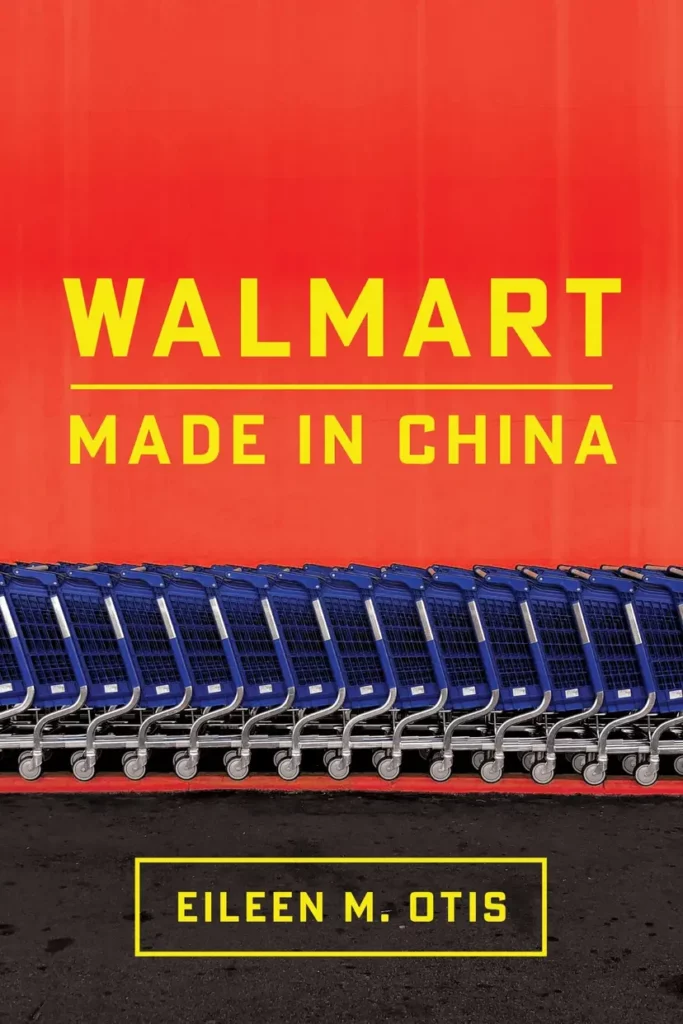
It is hardly news Walmart’s U.S. store shelves are filled with commodities made in China. Less recognized is the extent to which Walmart’s retail operations in China were thoroughly remade to adapt to that country’s labor regulations and unions, urban landscapes, consumer cultures, and post-socialist institutions. A stroll through Walmart’s aisles in Shenzhen, Beijing, or Shanghai, may convey the opposite impression: giant images of Sam Walton hover over customers, and yellow smiley faces line the aisles, while the slogan “Save Money, Live Better” invokes a budget version of the American dream extended to all. But the ubiquitous Americana is more ornament than substance, draped over a retail model fundamentally reshaped by China itself.
When Walmart planted its first of some 400 stores in China in 1996, the local terrain had been unwittingly cleared of viable competitors by over three decades of Maoism in which retailers became mere distribution channels, no longer subject to the pressures of profit. Walmart and its European and Japanese cousins faced little in the way of domestic challengers. Even so, Walmart was subject to local labor regulations requiring a full complement of employee benefits, overtime and scheduling regulations, enforced stringently in its stores. Unlike its U.S. brand, Walmart gained a reputation as a high-road employer; it paid well above median wages. Instead of massive stand-alone structures, its stores were forced to squeeze into densely-built urban environments, sometimes acting as anchors in budding shopping malls. It sold myriad locally produced products with which most Americans are unfamiliar including live fish and crustaceans from its water tanks. Vendor-dispatched sales agents populated store aisles in a multitude of costumes, dispensing samples and hawking products, creating renao or hot noise, reminiscent of local outdoor farmers’ markets. Even if its corporate culture was a US import, it resonated with distinctive elements of Maoist local historical experience as workers interpreted Walmart through moral expectations inherited from a radically different political history.
These dynamics of localization direct attention to a rather striking blind spot in existing scholarship. Political economists follow shifts in commodity chains around the globe but tend to stop at the threshold of the retail spaces where commodities are ultimately sold and transformed into profit. Sociologists of service labor, by contrast, dwell in retail spaces and reveal the aesthetic, emotional and relational labor enacted within. But these rich studies tend bracket the commodity itself. [1] Between the commodity chain and service labor process lies realization.
Realization is what Marx called “the second act” of the commodity. If the first act, production, injects the value of labor into commodities, realization encompasses all of the worker effort that moves the commodity through the store, across cashier stand and into customer shopping bags, to realize that original value as profit. Realization is a recognition that conditions must be constructed to transform commodities into money because realization of profit is by no means guaranteed by consumer demand. Rather labor is required to manage consumer markets and their uncertainty. This requires a vast range of labor activities: shelving, arranging, displaying, persuading, scanning, and bagging. Together, these activities can be understood as realization labor. I introduce the concept hoping to correct the longstanding tendency to privilege manufacturing labor as the paradigmatic site of capitalist activity while treating circulation as secondary, especially critical as the gravity of supply chains have shifted in favor of retailers like Walmart and Amazon.
The book follows commodities into the retail aisles of Walmart China, tracing the store’s “internal supply chain,” the organized flow of goods from the receiving dock to the customer’s shopping bag. Rather than treating the retail workplace as governed by a singular labor regime, the book shows that Walmart stores contain multiple, internally differentiated regimes of realization labor. The analysis draws on immersive observation in Walmart stores throughout the country, including shopping ethnographies conducted alongside local acquaintances who shared their perspectives on the stores, interviews with employees, and workplace data collected by research assistants employed in produce, sales, and cashiering positions. Tracing workers’ locations within the store’s internal supply chain, it reveals their differential exposure to corporate culture, customer interaction, surveillance, and gendered expectations surrounding embodiment and service interaction gave rise to three distinct labor regimes.
Produce stockers, for example, occupied physically demanding positions tied closely to inventory movement and store logistics, but received minimal exposure to Walmart’s celebrated corporate culture. Cashiers, by contrast, stood at the critical point where commodities were transformed into money and therefore experienced the most intensive forms of monitoring, customer discipline, and normative management. Between these groups stood vendor-dispatched sales agents, formally employed not by Walmart but by outside brands competing for consumer attention on the retail floor. These workers are largely absent from U.S. Walmart stores. These sales agents, mostly young women, were required to dress up as flight attendants, milk maids, cartoon characters, even futuristic astronauts in silver dresses, plying their products calling out the day’s special deals. Their labor transformed the retail floor into a crowded, lively theater of realization.
The concepts of realization labor and the internal supply chain help illuminate broader transformations in capitalism that elevated retail firms like Walmart and Amazon to lead the coordination of global supply chains and consumer markets alike, while foregrounding the labor processes through which realization is actively organized and managed. The big-box retail store, even in its more compact Chinese form, concentrates unprecedented numbers of retail workers under one roof in order to manage the immense logistical and organizational problem of realization, often facing shifts in global production and consumer demand that can be unpredictable. Through their varied activities, workers coordinate commodities across retail space and are central to securing the sale upon which value realization depends. By tracing the internal supply chain of realization labor, we can identify both the distinctive ways retail labor regimes are shaped by local institutions and consumer cultures, as well as the organizational logics global retailers replicate across national contexts. The framework is equally important for understanding the next stage of retail capitalism under digital and platform retail, where firms such as Amazon organize realization labor across internally coordinated systems linking digital platforms, warehouse logistics, algorithmic management, and last-mile delivery.
As capitalism becomes increasingly digital, realization labor does not disappear; it proliferates, albeit in new forms. The power of firms such as Amazon and Alibaba reflects the centrality of realization itself, as capital devotes ever greater resources to overcoming the uncertainties that stand between commodities and their conversion into money. Along with this trajectory, the future of labor politics will lie increasingly in the struggles that surround realization, as workers gain new forms of structural power through their capacity to interrupt the flow of commodities and the realization of profit.
[1] An important exception is Walking Mannequins, by Joya Misra and Kyla Walters (Berkeley: University of California Press, 2022).
About the Author
Eileen Otis is an Associate Professor of Sociology at Northeastern University and the Chief Editor of Work in Progress. She is the author of the award-winning book Markets and Bodies: Women, Service Work, and the Making of Inequality in China.
Read More
Otis, E. (2026). Walmart: Made in China. Stanford University Press.