
 In 2006, Muhammad Yunus and his organization the Grameen Bank were awarded the Nobel Peace Prize for pioneering microcredit programs to the poor in Bangladesh. This was the culmination of nearly two decades of the international development field’s confidence in microfinance to bring social and economic development. The rise of the microfinance movement reflects what the former World Bank Chief Economist Joseph Stiglitz calls the social turn in international development, characterized by the inclusion of social dimensions, such as gender and inequality, in development practices.
Critical social science scholars offer different interpretations of this social turn, including the appropriation of gender equality for neoliberal goals, the reliance on private solutions to poverty, and the mischaracterization of precarious and exploitative work as entrepreneurialism.
Home-based workers repurposed as entrepreneurs
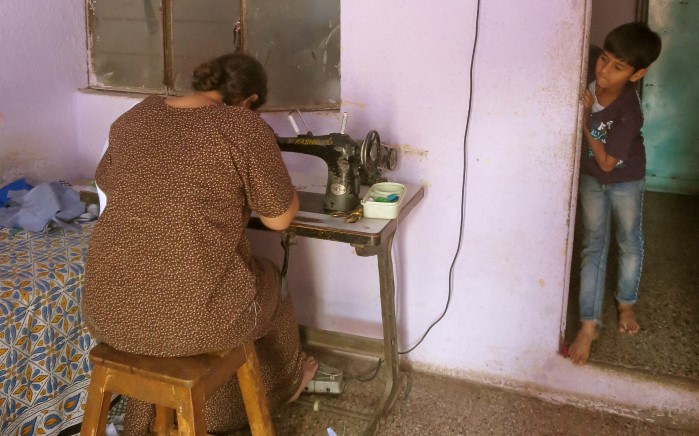
Considering the hype around microfinance, entrepreneurialism, and the belief in the empowering potential of work, I was interested in comparing these ideas to the lives of women actually working in the informal economy. I spent a year in Ahmedabad, a large city in northwest India, conducting research with women home-based garment workers. Because of the work setting and an ambiguous employee-employer relationship, home-based workers are often mistakenly refashioned as self-employed micro-entrepreneurs.
Similar to current debates over the gig economy (such as Airbnb, Uber, and TaskRabbit), there are two interpretations of the informal economy: entrepreneurship or exploitation. In my research I found that women home-based workers reflected both sides but with caveats. Their experience with work was due to labor market forces that create low-wage, irregular work, but also to their social positions as poor women belonging to lower-caste or religious minority groups. Because of social and cultural customs, including household and caregiving responsibilities, these women could not work outside. Yet, they had to work because of their household’s economic position. As one participant, Biliksha, admitted, her family allows her to work because “our household needs money, otherwise, I would only do household work.”
Home-based work allowed women to be economically active while not conflicting with their gender roles in the family and community. However, home-based work is very irregular, low paid, and highly exploitative. Home-based work offers an opportunity to work, but the industry takes advantage of women’s limited social and spatial mobility to create a cheap and expendable labor force.
 Job satisfaction matters. Of course, everyone would like to be happy with their work. But beyond that, scholars have also shown that job satisfaction is crucial for workers’ mental wellbeing and physical health, on the one hand, and important for employee performance and retention, on the other hand.
 High-involvement models of working are associated with high levels of worker influence over the work process, such as high levels of control over how to undertake job tasks or involvement in designing work procedures. We have recently published a review of the literature to find out what is known about the conditions that foster the adoption of such high-involvement models. We draw on studies of worker participation in management since the 1950s to explore what explains the dispersion of high-involvement work processes in the private sector.
 Asian Americans have increasingly been in the national spotlight. Last month, “The Chinese Exclusion Act,” a documentary by Ric Burns and Li-Shin Yu, aired nationwide as part of PBS’s American Experiences series. The film
  In January 2012, President Obama called for states to extend compulsory education in the U.S. to age 18. More recently, the White House unveiled its


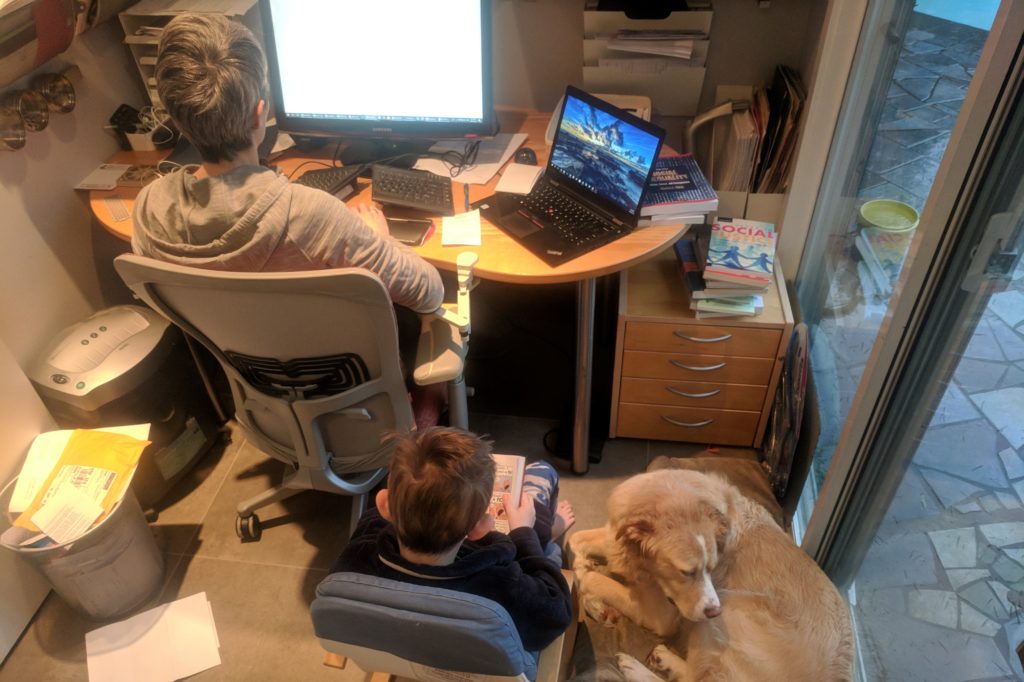 For many families, integrating work and care remains a challenge. Is flexible work the answer? By affording workers greater freedom to organize their jobs in ways that suit their lives, flexible hours and the ability to work from home can help parents meet children’s needs while still getting their work done.