
Commentary, New book

Author Meets Critics: Engaging Hatim Rahman’s Inside the Invisible Cage

, and
May 20, 2025

The following is a loosely edited transcript of the Author Meets Critics event devoted to Hatim Rahman’s Inside the Invisible Cage (University of California Press, 2024). The event was held on April 8, 2025 and sponsored by Work In Progress. The actual hour-long video will be posted soon.

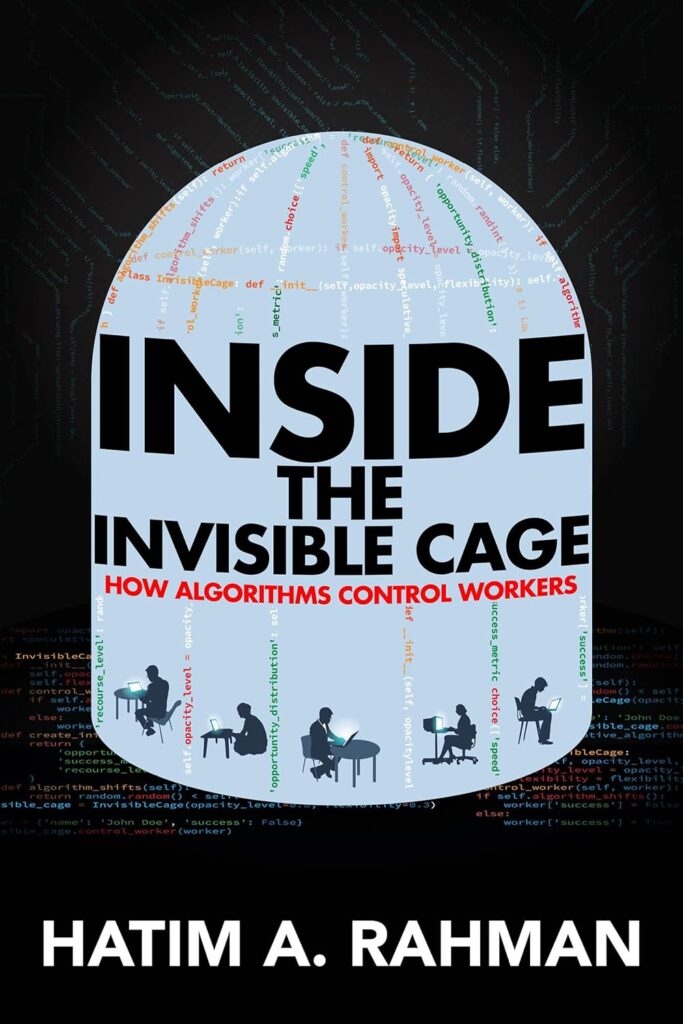
Inside the Invisible Cage provides an in-depth account of “TalentFinder,” the pseudonymous platform that has become the dominant provider of on-line freelancer services in the world. The book stands as the most important analysis of the mechanisms that crowdworking platforms use to control the behavior of the highly skilled contractors and consultants they attract.

Continue Reading…
Research Findings

Networking or nepotism: How young people balance social capital and meritocratic logics in the job search

and
May 6, 2025

At this point it has become common knowledge: leveraging your social capital will help you on the job market. We hear it from scholars, who illustrate the benefits that job candidates get from referrals; from career counselors, who encourage us to reach out personal contacts at companies where we hope to work; and online, where we are relentlessly reminded to expand our professional networks to advance our careers. To get a job, it often seems, you have to know someone.

Yet leveraging connections during the job search is at odds with another widespread belief, that hiring should be meritocratic, based on candidates’ qualifications rather than their connections. This gives rise to a tension. On the one hand, we want to maximize our chances of getting the job by getting a foot in the door. On the other, we feel committed to the principle of meritocracy and concerned that using connections may shade into nepotism.

Continue Reading…
New book, Research Findings

Play, obey, submit: How Elon Musk’s gamer brain conquered Silicon Valley—and now America


April 21, 2025
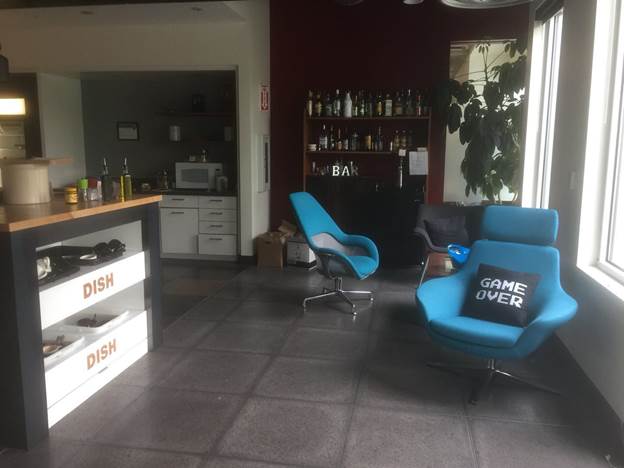
Open kitchen setup with a mini bar, chairs with “game over” pillows, a pool table, and bar booths. (Photo by Tongyu Wu)

Elon Musk doesn’t just play video games—he lives them. He’s crafted a worldview where life is a conquest, every obstacle is a puzzle, and people are mere NPCs (Non-player characters).[1] This mindset now fuels his leadership at the Department of Government Efficiency (DOGE), where he is speedrunning the U.S. government like it’s Factorio[2] on hard mode: slashing staff, hacking bureaucracy, and treating national infrastructure like a sandbox to break and rebuild. His guiding principle? Cut, tweak, dominate, repeat. Musk has bragged about drawing strategic insights from games like Polytopia, Factorio, and Elden Ring.[3] He even admitted to cheating in order to climb leaderboards in Path of Exile 2. Because for him, the only rule is to win. These aren’t fun facts about a quirky billionaire; they’re a warning signs. Musk is exporting a gamified mindset that sees conquest as creativity, and rules as optional.

Continue Reading…
Research Findings

Social mobility in Africa: A complex reality.

, and
March 18, 2025

In recent decades, terms such as “meritocracy” and “equality of opportunities” have gained significant political and social traction, while the globe has experienced recurring economic and social crises that widened the gap between the haves and have-nots. Amid this growing inequality, one must question whether true social mobility still exists. Can today’s youth, regardless of their background, genuinely aspire to climb the economic ladder, or are they bound by the socioeconomic status they were born into?

Continue Reading…
Book review

Class, Power, and Digital Technology: A review of Fourcade and Healy, The Ordinal Society


March 4, 2025

Digital technologies have woven themselves into every facet of our lives, introducing shifts –sometimes subtle, sometimes quite profound— in the workings of virtually all social institutions. Arguably, the most important of these shifts concerns the link between digital technology, power and social inequality. How have digital capitalism and algorithmic management reshaped the mechanisms that stratify people, now reborn as “users,” into distinct classes and strata? What do these shifts mean for the theoretical frameworks we have inherited from the past? In their important 2017 paper, Marion Fourcade and Kieran Healy argued that the use of digital systems to harvest almost unlimited data about individual users has rendered obsolete many of the core assumptions that have long informed sociological thinking about class, status distinctions and social inequality generally. Now, in their 2024 book, The Ordinal Society, Fourcade and Healy have contributed a more richly developed analysis of the many consequences that flow from the automation of class inequality (see Eubanks’s 2017). The result is a deeply researched, provocative but often frustrating book. It deserves a wide audience for reasons I spell out below.

Continue Reading…
New book

What went wrong: A different diagnosis


February 17, 2025

            Antonio Gramsci wrote in 1930: “The crisis consists precisely in the facts that the old is dying and the new cannot be born. In this interregnum, a great variety of morbid symptoms appear.” Trump’s reelection even after the January 6th insurrection and the widespread embrace of scapegoating and conspiracy theories are today’s morbid symptoms. In The Habitation Society: Paths to Sustainable Prosperity, I argue that both our politics and our economy are so damaged because we have been unable to transition from an industrial society to a habitation society.

Continue Reading…
Research Findings

Republic of Fear? Complexity and Coercion in Amazon Warehouses


January 20, 2025

Not long ago, labor scholars and activists fastened on Walmart’s labor practices as providing the most influential template for the “low road” approach toward employment generally. Since then, Amazon has in many ways surpassed Walmart, overtaking it in many retail markets, and bringing into play a whole new set of labor practices, many of which are equipped with powerful digital surveillance tools. This raises the question: What, precisely, do we know about the labor control mechanisms that workers encounter in Amazon’s warehouses? Despite journalistic forays and scattered but growing academic research, we have only a faint and tenuous outline of the company’s managerial regime, and of the workers’ responses to it.[1]

Continue Reading…
Research Findings

The romance and reality of “authentic” craft spirits


December 21, 2024

Imagine a small, rustic distillery tucked away in Utah’s Uinta mountains. The air is crisp with hints of fermenting grain and aging whiskey. Inside, a dedicated artisan tends to the copper still, crafting small batches of handmade spirits with care. Each bottle reflects the maker’s dedication and knowledge of the land.

This romantic image is likely what comes to mind when we hear “craft spirits.” We envision devoted producers pursuing their passion for making unique, quality products that stand in contrast to those mass-produced by big-name brands. It’s no wonder, then, that the craft spirits industry has seen such impressive growth in recent years.

But how accurately does this idealized image reflect the reality experienced by craft distillers? In a recent study, forthcoming in Qualitative Sociology, my colleague Eylül Yel and I shed new light on this question, revealing a landscape far more complex than this idealized vision suggests.

Continue Reading…
Research Findings

Work is Freedom: The Entrepreneurial Self among Street Vendors


November 18, 2024

When I asked a Latin American street vendor in NYC if he has free time, he replied: “For what? This is my freedom, work is freedom. This is fun for me. Some people may pass by and think, ‘poor man selling churros in the street in such a cold weather’, but I do not feel like that, I feel good, I make money.”

Precarious work has increased globally in recent decades, influencing workers’ perceptions of their jobs. A defining feature of precarious work is the combination of bad working conditions with greater autonomy and flexibility. As a result, workers from various sectors, including freelance workers, platform workers, entrepreneurs, and street vendors highlight the benefits of working for themselves.

Continue Reading…